Wednesday, April 10, 2013

Reflection 1

The class topic and discussion for today on Arab women in American media really stood out to me from our other class discussions. What struck me first was that we barely had a list of any prominent Middle Eastern woman in our media in comparison to our previous class discussions on other ethnicity and their representations in the media. There are very few Middle Eastern actresses in movies because they are only given minor roles and also if they are in movies and they embedded in the movie as almost like the background. I didn't realize how spot on that was until we saw the film, "Reel Bad Arabs" and the the clips from Sex and the City 2.Women of ethnicity who are not white are often hypersexualized in the media and Americans tend to hypersexualize what is foreign to them. For example, belly-dancing is a part of the Arabic culture just the same as Japanese wearing kimonos and performing their tea dance ritual. However, we see how in movies, these cultural practices are portrayed in the media with the male gaze and to serve the white men.

In the clip from Sex and the City 2, the Middle Eastern women revealed that underneath their veils, they love fashion and wear clothes that everyone else wears also. We discussed how patronizing that moment in the movie was and that made me think about my own experiences. My sister's best friend from high school was Arabic and I remembered she always wore an Abayah,which covered her clothes underneath, and a Hejab, which covered her hair. When I went to her bridal shower when I was maybe 15 or 16, I had similar reaction like the women from Sex and the City when they saw the American clothing underneath. At the bridal shower, all the women wore very fashionable clothing and styled their hair and it surprised me and I never thought of my reaction and thoughts to be patronizing.

I enjoyed our class conversation on the issue of veiling and whether or not it oppresses women or not and why has this custom of wearing veils have existed for centuries. I agree with everyone in the class that the veil is not oppressive at all but rather it is a choice because some wear it and some don't. I didn't realize that in American culture, we ourselves have veiling too  such as wearing veils on the wedding day for the bride or even the nuns.Certainly, who are we to judge other cultures and tell that that wearing veils is "oppressive to women." When we think about why veils have survived for centuries, we have to remember that these are their set of values that very much embedded into their culture. It is so dangerous when people are not educated about other cultural practices such as the veils that Middle Eastern women wear because to say they should not wear it because it is oppressive is racist.

In our previous class, we discussed how categorizing people who are "Asians" is a loose and general term used for all of those countries and the billions of people are all under that one category. Categorizing people as "Middle Eastern" women is also a loose word to describe so many different type of people who all vary from one another and are represented as mainly oppressed and veiled. In my life, I have met many Middle Eastern women and they are all so different from one another. I knew someone who is always veiled by choice. I have a friend who rejects wearing veils and adopts the American way of thinking and lifestyle and says she is happy she is living in America and not in the Middle East where she fears she would have been oppressed. I knew another person who is Muslim and the oppression that she faces everyday from the men in her life makes her very depressed every day. These three people I just mentioned, they all vary from one another in their faith, values, practices, and even in their every day life and the media does not show the different dimensions of Middle Eastern women as individuals.


Reflection 1:


           One of the things I was not aware of before our class this week was my lack of knowledge about the Middle East. I relied way too heavily on the information being provided by media outlets and did little research of my own. It was class today and the articles for this week that helped me truly see the distinctions between Arab, Middle Eastern, and Muslim. I had used them interchangeably and never realized the political implications that came with the terms.
            A very interesting topic from the articles and the class discussion was the veil and the real meanings behind it. I had always seen it as a symbol of oppression but I have learned it is cultural and has been used in a way to empower women and allow them to express their religious values. The discussion in class also helped me see that even in the Western world we have a form of veiling and ways to oppress women’s ability to speak freely. In one of the articles it was stated that American women were sending over makeup and other cosmetics to give these veiled women freedom to do what they want but in reality it was just switching out the “Eastern” form of veiling for a “Western” form.
            This week’s discussion made me think about ways we in America oppress our women. Thinking back to the article “The More You Subtract, the More You Add” we see advertisements that state things such as “Let them do the talking” referring to  nail polish and silencing the woman who is wearing it. In the Western world women should allow their clothes to do the talking; to be seen not heard. The article also touches on the way women are posed in ways to cover the mouth or to show a subdued nature. I found it very interesting how Princess Hijab used the veil to reveal and cause discussion about topics such as the way women are portrayed.  Why does America think we can “save” Middle Eastern women from oppression when we live in a culture that oppresses women?
These articles were very thought provoking and truly made me question all the things I had simply overlooked in the past. It also made me realize how much the media and government rely on these messages to help justify the war. Being an American who was very young when 9/11 happened I was spoon fed these ideas of savagery and oppression, and never even questioned it. It is truly scary the things that we take away from media subconsciously and without further question.

Reflection 1

After our class discussion about Muslim women in the media and having read the articles and watched the documentary, I felt that I learned a lot of things that I was unaware of, particularly concerning the veil. Someone in class mentioned thinking that the veil was worn by all Arabs and Muslims for religious reasons, and I was definitely under that impression as well. I also thought that the veil had something to do with preventing men from pursuing married women, as if women were property to their husbands. In other words, I believed the stories in the media.

 But what I learned today and from our readings changed my perspective. I feel better able to understand the reasoning behind wearing the veil, which is simply due to cultural customs. It had never occurred to me that these women might feel most comfortable wearing the veil, which is probably because we have projected onto it our own western ideas about it being oppressive. Not only have politicians given us this idea, but movies and television are guilty, too. For example, in the Sex and the City clip we saw today, Carrie was fascinated/shocked by the women wearing veils while eating their lunch, even at one point mentioning in a disgusted tone, the fact that it covers their mouths. These are the impressions we, as the public have been given about Middle Eastern women, and I’m glad to now have a better understanding of their culture and opinions.

 Furthermore, I found learning about the distinctions among all the different countries and cultures in the Middle East very helpful. It’s never been clear to me which countries would be considered “Arabic” or “Muslim,” and I was certainly surprised by just how much the media, and the public as a result, generalize with those umbrella terms for certain areas. I have many Arabic friends and even some family through marriage who come from Jordan, but I did not know the extent to which the Arabic culture extends over the Middle East. And it is this constant generalization from the media which serves to keep us informed without really informing us. We think we have a good understanding of the way that other people live, only to find out that we've been getting a single story through the media. And now that I'm aware, I feel better able to question what I hear and see, and hopefully gain more than one story through those questions, like I was able to do today.

Reflection 1

The classes that we've had so far have been really informative in making me more aware of the stereotypes present and are continually being perpetuated in the media.

One of the girls in class, Megan, posted a link here to the video about Korean women who are going under the knife to look more "western" and I immediately thought of my last visit to Philippines and Japan. I visited the two countries within the last two years and the influence there of "western" looks and beauty standards is shocking. People are so obsessed with getting fair skin, having double eyelids, thinner facial structure and etc. I remember visiting stores that sell numerous whitening products and eyelid tape to create an illusion of having double eyelid. I also know of several Asians who live here in the US that specifically visited Asia to get plastic surgery done.

 I also recall from one of our readings from week 8 by Renee Tajima, she talks about how white actresses were often used to play Asian roles in movies. I think the term they used now is "whitewashing". I remember seeing the movie The Last Airbender which was based on a show from Nickelodeon and the main characters there were supposed to be Asian but yet in the movie they cast white actors to play the roles. I also recently saw the trailer for Iron Man 3 and there was a character named The Mandarin and the actor playing him is Ben Kingsley. I had to do a double take because I was shocked that they would pick another white actor to play an Asian character. I am certain that there are more than enough Asian actors/ actresses out there to play those roles and yet Hollywood still keeps picking white actors/ actresses. Even if they do pick Asians, it is always the usual ones like Jackie Chan, Lucy Liu, Zhang Ziyi, Ken Watanabe, etc. I think Hollywood and the media need to open their eyes and stop stereotyping because there more than enough creative people to create narratives that are not like the usual.

physical health and mental health


i saw this truck in union square. and honestly, i think because of how embedded images like this are to our culture, were it not for this class encouraging us to pay attention to the media around us and the way it is used to sell products, i maybe would not have noticed this as anything noteworthy at all.

but of course now i do. and when i see this i can ask questions about it. i can ask myself what this is trying to sell, how does it hope to achieve the desirability of the product, does it work, and most importantly what/how does this contribute to our everyday culture by being surrounded by strategies like this.

i think the ironic thing about this media moment si that what it's trying to sell is supposedly physical health: "new comfort food and cold pressed juice." this is selling you vitamins, nutrients, and natural foods. but this physical health is directly tied into the creation of mental and psychological malnutrition. the tactic to make the health food products enticing to the viewer is that they will bring their customers closer into looking more like those bodies we see being advertised on the truck. the paradox is that the health foods is encouraging you to have unhealthy perspective about your own body as it is right now.

is there any way to escape these images of physical perfection, even as businesses are trying to lure their customers, supposedly, into physical health? or are these images of perfection and galmour just so deeply embedded and a part of advertising's fundamental vocabulary that they will just always be synonymous to advertising culture?


Reflection #1

Reflection on Week 8 discussion


We discussed stereotypes surrounding Asianness, specifically that of Asian women and their depictions in western mainstream media. What I never really reflected on is how narrow the "Asian" concept is for most Americans including myself. This being Asian people as people who are from China, Korea, Japan, Taiwan, Vietnam, and a few other places where the look is predominately what we know to be as Asian, not places like Kazakhstan, Turkmenistan, Iran, Brunei, United Arab Emirates, Qatar, Kuwait, Saudi Arabia, Bahrain and Oman. People from these places are placed in a more specific bubble, e.g. Saudi Arabian, instead of what we as Americans consider Asian, e.g. Japan and China. If you are from places such as China, Korea, or Japan, you are lumped together as Asian by most people who can't immediately see a difference.

Along with this, I have never realized how much every group of people that aren't specifically "white" are subjected to negative representation by the media, this representation usual being hypersexualization. This representation has hit asians, arabs, blacks, hispanics, and most likely more that I just haven't seen yet. The stereotypes are always lasting impressions and prejudgments based on extremely limited empirical evidence, and I don't see them ending anytime soon.

Tuesday, April 9, 2013

Media Moment: Sheryl Sandberg with Jon Stewart

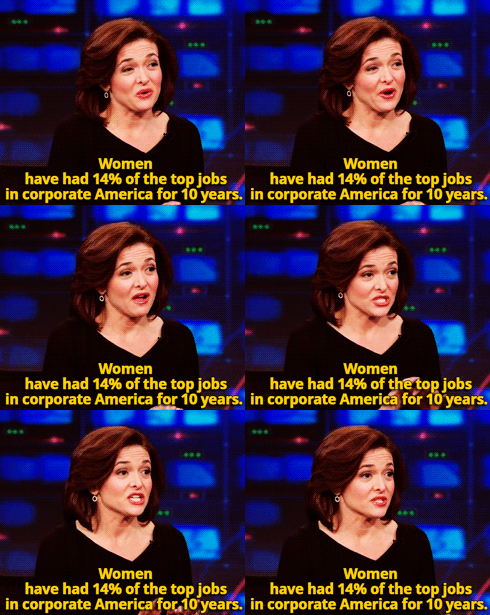
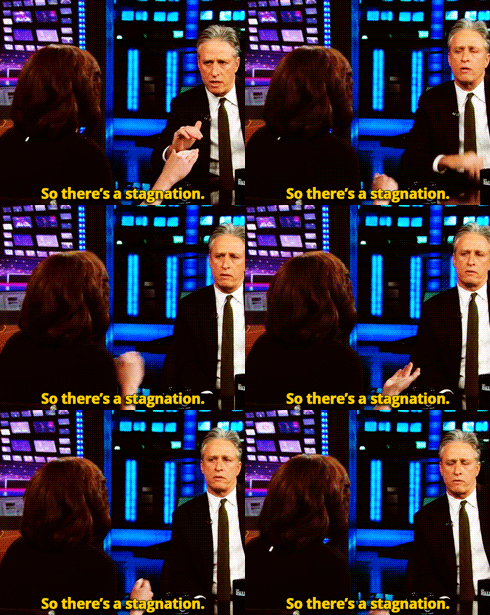
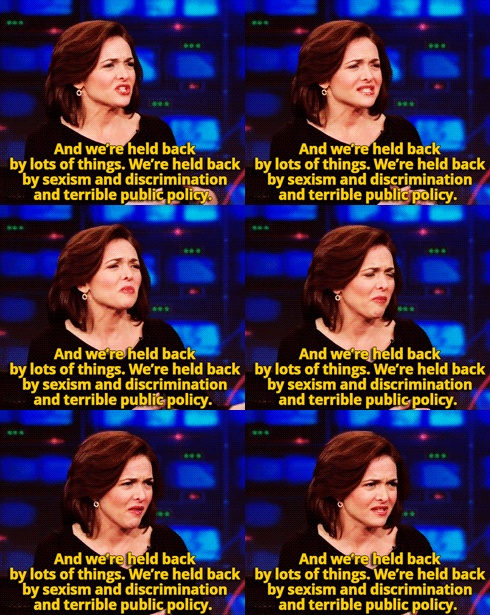
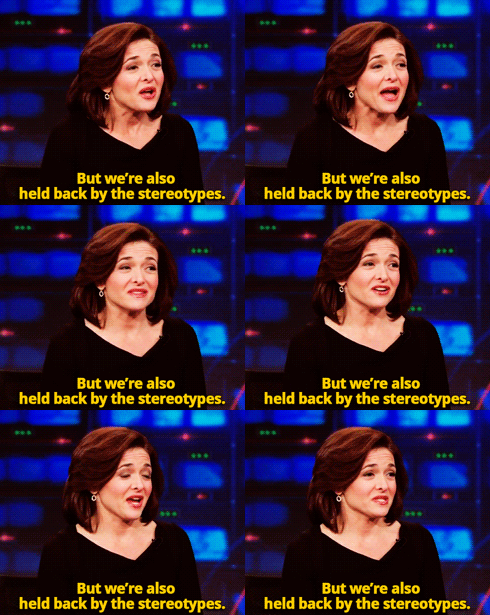
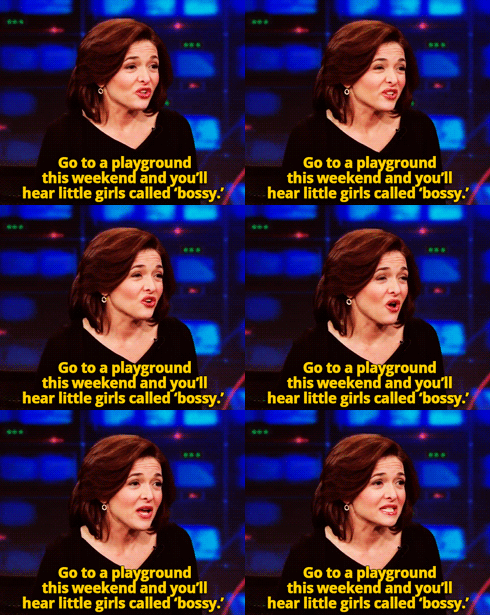
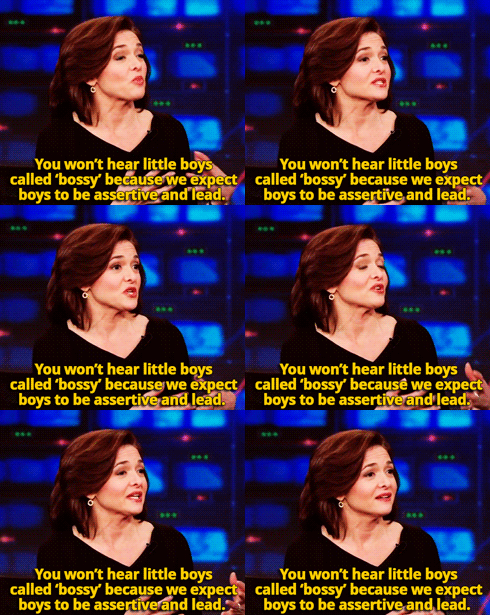
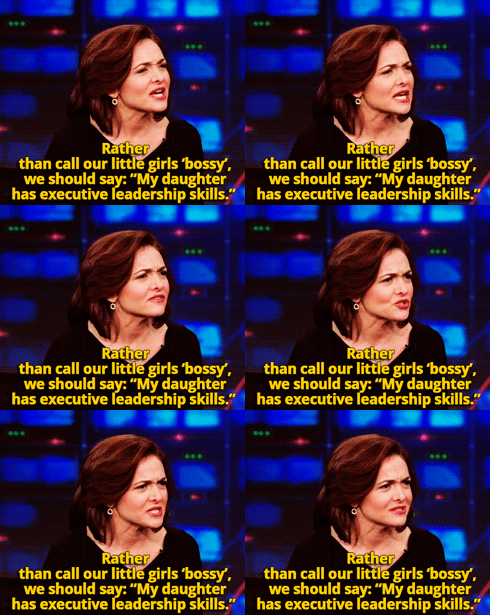
I came across this gif compilation on Tumblr and in doing more research found that it was taken from an episode of The Daily Show with Jon Stewart, featuring the COO of Facebook Sheryl Sandberg, pictured here. As you can probably tell, she is discussing some of what she wrote about in her new book called Lean In, which is about the inequality between genders in the workforce and how it still manages to be part of our mostly progressive lives today. She suggests simple changes to our ways of thinking in order to change the fact that men are still able to succeed more in the work force as opposed to women. Things like saying that our daughters have "executive leadership skills" instead of calling them "bossy" could make all the difference in our daughter's minds as they grow, as well as in the minds of the males around her if we are conscious enough to change our own ways of thinking. The interview has two parts, and she discusses her book and ideas much more in depth, but unfortunately the videos wouldn't embed here so, I'll include the link to Jon Stewart's site below. Do you think that women are still suppressed in the work force? To be honest, I haven't had much experience to really say, as I've held down the same job for the past 5 years, so I would love to hear some of your thoughts/experiences. Also, do you think Sandberg's theories about changing our ways of thinking, and in turn, our children's could help the situation? The interviews: http://www.webpronews.com/sheryl-sandberg-talks-women-and-leadership-on-the-daily-show-2013-04